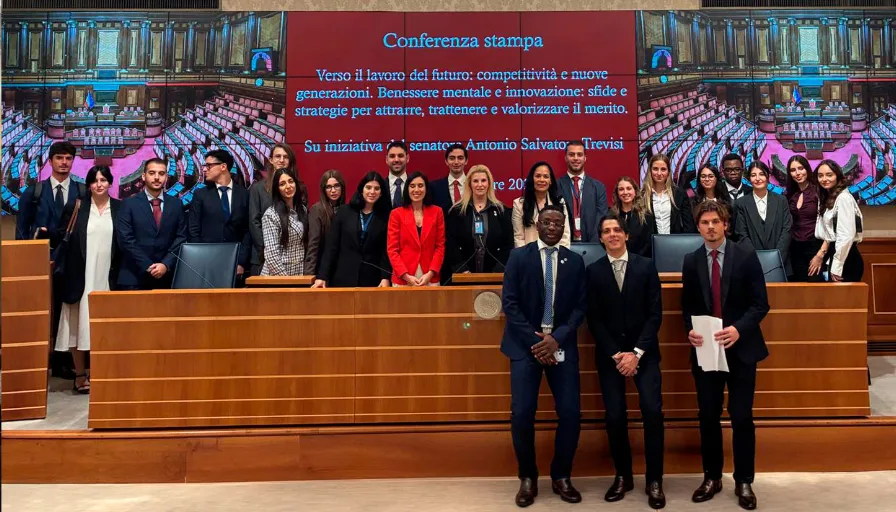

Rome, October 15, 2026. The VIAHR Foundation addressed the Italian Senate today. Its president and founder, María Méndez, spoke at the conference “Toward the Future of Work: Competitiveness and New Generations,” held in the Caduti di Nassirya Hall of the Palazzo Madama, at the invitation of Senator Antonio Salvatore Trevisi.
The morning was devoted to a question that concerns every country: how to attract, retain, and make the most of the talent of the younger generations. VIAHR’s answer has a clear starting point. “People’s well-being is a prerequisite for competitiveness,” Méndez told senators, speakers, and students.
The president of VIAHR began her remarks by citing Article 36 of the Italian Constitution, which recognizes workers’ right to weekly rest and paid annual leave—rights that cannot be waived. “Seventy-eight years ago, the framers of the Constitution understood what science confirms today: people who rest work better, live better, and build a healthier society,” she said.
This principle is in line with Article 24 of the Universal Declaration of Human Rights, which inspired the foundation’s name: Vacation Is A Human Right. Méndez devoted a central part of his speech to young people. According to the World Health Organization, one in seven adolescents between the ages of 10 and 19 lives with a mental disorder. An international meta-analysis of 192 studies indicates that nearly half of all mental disorders emerge before the age of 18. Deloitte’s 2026 Global Survey reports an improvement in mental health as reported by young people, yet also highlights a challenge that remains: 34% of Generation Z feels anxious or stressed always or almost always, and 47% report experiencing burnout. Seventy-one percent needed time off due to stress; only 41% actually took it.
“Behind every percentage is a name, a family, a life plan,” Méndez noted. The WHO also estimates that depression and anxiety result in the loss of 12,000 million workdays each year, at a cost of one trillion. Mindful pauses can be learned
In light of these findings, VIAHR proposes the PAUSA® Method, a five-step approach to mindful pausing: Stop, Accept, Center, Simplify, and Connect. “These are five steps that are simple to explain but challenging to put into practice. That’s why we teach them the same way you’d teach a sport: through practice, consistency, and guidance,” he explained.
The president presented three specific proposals to the chamber.
- In education, teaching young people to recognize stress, to stop in time, and to ask for help naturally—from elementary school through college: “Knowing how to take a break is something you learn.”
- In terms of measurement, assess well-being in companies using internationally validated tools.
- In recognition of this, to give public visibility to organizations that invest in prevention and put people first.
Méndez expressed the hope that the event would lead to an ongoing dialogue with the institutions,
Italian universities and companies, through a pilot project aimed at young people entering the workforce. “We must tell these young people that their worth is also measured by their ability to pause, listen to themselves, and start over,” he said, addressing the students in the room.
The Foundation invited Italian institutions to join it at its Fourth International Congress, “The Power of Pause in High Performance,” to be held on November 19, 2026, at United Nations Headquarters in New York. On that occasion, VIAHR will present the first edition of the Global Awards for Human-Centered Business Excellence, dedicated to companies that put people at the center.